


Welcome back to Slacker Stuff, a weekly column for professional creatives, heads of content, or anyone else aspiring to be a creative leader.
Too Much Good Stuff
When I was in the 4th grade, there was a party at school. We had a bounty of treats: cookies, pizza, and soda. I had unrestricted access to anything I could take in. Naturally, I decided to drink about five Dr. Peppers.
Folks, I was absolutely flying: bouncing off the walls in every direction, sweating it all out on the blacktop as I played with my school chums… the real damage happened later that night.
I couldn’t sleep. Surprised? Well, 200mg of caffeine coursing through a 10-year-old boy’s body and brain will do that. I did what I usually did when I couldn’t sleep, and I made my way to my parents’ room, naively believing that mom or dad could figure out how to get me to sleep.
On this night, as soon as I entered their room, I saw a commercial. It was a “Got Milk?” commercial with a woman suffering from the heat in her car. She peeled her skin off, and her skeleton got out of the car and grabbed a bottle of milk from some place nearby.
I’ll be so honest with you: I have not looked up the commercial to confirm any of the details because I would prefer not to re-live that trauma. I also don’t want to risk any other young kids accidentally seeing it as they peer over your shoulder while you read this. I’m sure you can find it if you search for it.
It shook me to my core. Why would anyone feel compelled to strip off their skin suit and just be bones? Could that happen to me? What if I woke up like that? I’m sure my mom and dad saw the horror on my face as I stood there, petrified, eyes wide and mouth agape.
I don’t remember how long it took me to get to sleep, but I’m sure it took quite a while..
Mother Knows Best
It wasn’t a one-night issue. The next night, and many nights thereafter, I struggled to fall asleep. I think I was scared that I would see that skeleton lady in my dreams, and my brain told me, “Well, if you don’t go to sleep, you won’t see the skeleton lady”. It didn’t help that I was frustrated with not being able to sleep which, fun fact, doesn’t help one fall asleep.
One thing that became part of the routine that helped me figure out how to fall asleep was that my mom would sit at her “post” outside my door, where I could see her from my bed. She would work on her Master’s Degree while I would focus on not focusing on sleeping (so I could sleep).
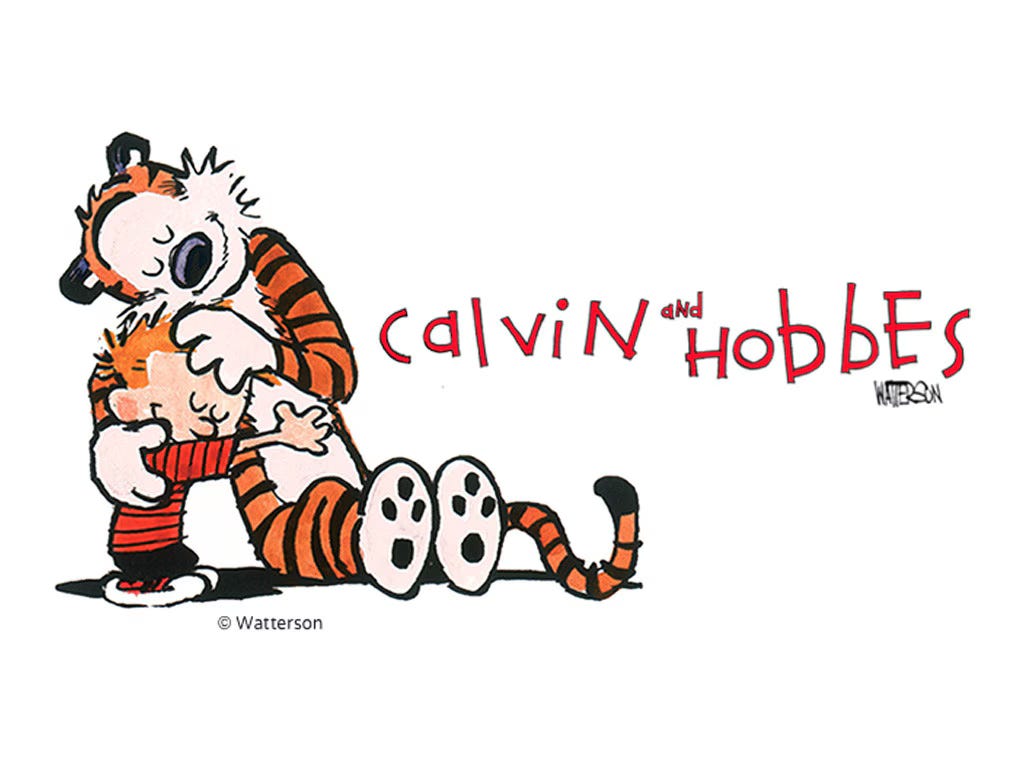
While having a mom guardian was helpful, I needed more to fully unlock sleep. We tried a number of things, but one thing worked better than the rest: One day, at the bookstore, I saw a cover with this little guy who kind of looked like me, who had a stuffed cat as a companion (I, too, had a stuffed animal kitty companion). It was a collection of comic strips called “Calvin and Hobbes”. Calvin, with his stuffed tiger Hobbes, got up to various hijinks and adventures driven by his wild imagination.
I would sit in bed and read through the comics until I got sleepy, sometimes drifting away to sleep while the book was still in my hands. Folks, I was not and am not a voracious reader. I know my parents were happy for me to indulge in this fixation on Calvin and Hobbes books. Sure, there were a lot of pictures, but there were words too, so I’m counting it as reading!
Knowing what I shouldn’t do
Calvin and Hobbes was created by Bill Waterson. First launched as a newspaper comic strip in 35 newspapers in 1985, it wasn’t long before Waterson saw success. Within a year, 250 newspapers carried the comic. By 1995, Calvin and Hobbes ran in 2,400 newspapers and was read by hundreds of millions.
Waterson distributed his first collection of comics in 1987. In total, there are nineteen official Calvin and Hobbes books. By my count, I think I have at least twelve of them and a few of the anthology books. Whenever we’d go to a bookstore, I’d look for one that I didn’t yet have, and my parents, as mentioned, took little convincing to purchase them.
My nightstand had a little cubby where all of the books fit nicely. If one of the books became too familiar, I could easily grab another book to keep it fresh. I don’t really remember specific stories or narratives. It all kind of blends together. I remember Spaceman Spiff, Calvin Ball, I remember Calvin’s expansive backyard, and the contrast of personalities between him and Hobbes. Most of all, I remember feeling seen.
To sum up Calvin, I found a newspaper clipping from an interview with Bill Waterson. He says,
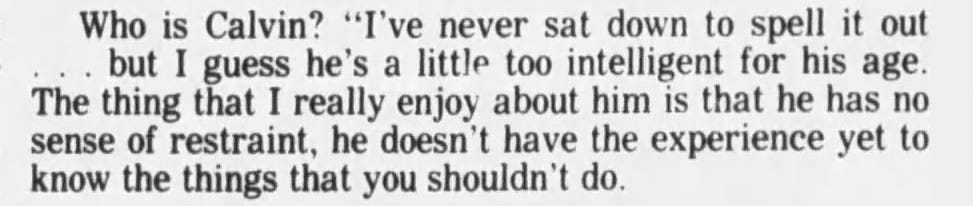
Looking back at what I did when faced with unchecked access to Dr. Pepper, the description feels very on the nose.
So there you have it. Calvin and Hobbes, paired with my mom at the door, won out against skeletons and insomnia. But, for all that Calvin and Hobbes are ingrained into the fabric of my childhood, they didn’t go far beyond my nightstand cubby. Not by my design, but by Bill’s.
Respecting the Craft
The access I had to stories as a kid felt limitless. I remember the TV schedule on Friday afternoons, I remember when we first got cable and spending the entire day glued to the couch watching Disney Channel and Nickelodeon, I remember the gameboy and gamecube games that I’d rotate through. There was always something new, always a continuation of narratives that a kid like me could indulge in.
But Calvin and Hobbes was different. There was no continuation or sequels beyond its initial run. Bill Waterson was staunchly against marketing and distributing his intellectual property beyond the initial run of newspapers and the anthology books. For him, the work he did was enough.
In a separate clipping, Waterson was described as such:
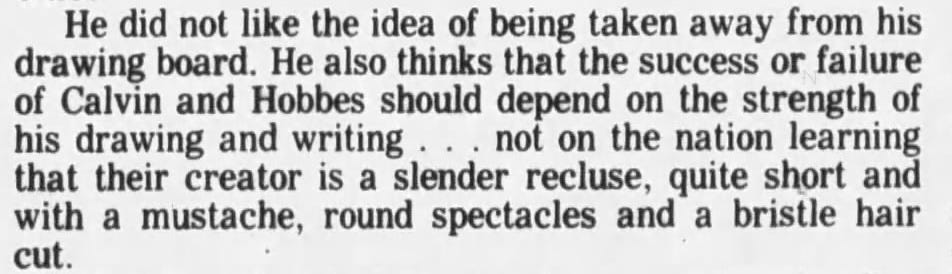
Calvin and Hobbes’ initial run ended shortly after I was born. Bill Waterson gave us Calvin, Hobbes, and the rest from 1985 to 1995. A ten-year run and that’s it. After it finished, he was pretty much satisfied.
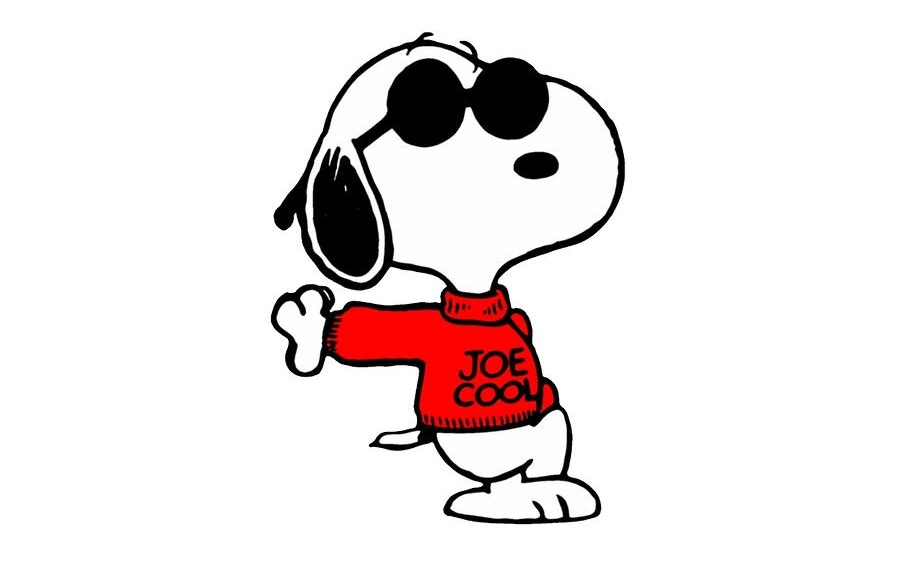
There was also no taking the IP and turning it into other marketing opportunities: merchandise, TV shows, even theme park licensing are ways cartoonists can capitalize on the popularity of their work. Look no further than Peanuts, created by cartoonist Charles M. Schulz. You can buy a Snoopy thermos, you can ride a Snoopy ride… Snoopy will sell you insurance, paper towels, and root beer. I’m sure you’ve seen the characters frequent the Macy’s Day Parade, come to life on the Broadway Stage, or you make it appointment viewing for their TV special on Christmas.
The opportunities are lucrative, too. Just last year, Sony Pictures took a majority stake in the Peanuts franchise for a “Joe Cool” half a billion dollars.
Bill Waterson had all the opportunity in the world to capitalize on the success of Calvin and Hobbes. Over the comics’ 10-year run, Waterson was in a constant battle with his publisher to cash in on the merchandising opportunities. He never relented, threatening to walk away from his contract if the publisher sold out. It is estimated that Calvin and Hobbes could have fetched Waterson between $300 and $400 million had he simply said yes.
In “The Calvin and Hobbes Tenth Anniversary Book”, Bill Waterson volunteered his thoughts on the matter:
“I have several problems with licensing. First of all, I believe licensing usually cheapens the original creation. When cartoon characters appear on countless products, the public inevitably grows bored and irritated with them, and the appeal and value of the original work are diminished. Nothing dulls the edge of a new and clever cartoon like saturating the market with it.”
I’m struck by Waterson’s commitment to his principles. In a world where Snoopy is probably going to be in the next Avengers Movie at this point, it’s refreshing to hear about an artist vehemently against that kind of character expansion. Upon the comic’s end in 1995, Waterson expressed that he was satisfied with what he had done and had no further need to continue
There is no TV cartoon of Calvin and Hobbes, there is no theme park, there is no movie. And there never will be because Bill Waterson was full and did not need to risk his creation for a quick buck.
Doing the Best with What I Know
In my research for this piece, I rediscovered a strip about Calvin discovering an injured baby raccoon in the woods. I encourage you to check it out yourself but, spoilers, the raccoon doesn’t make it. It’s heartbreaking to see a naive 6-year-old come to grips with what death means and how unfair it is that an innocent animal perished so soon after entering the material world. I cried while re-reading it. It was a good cry.
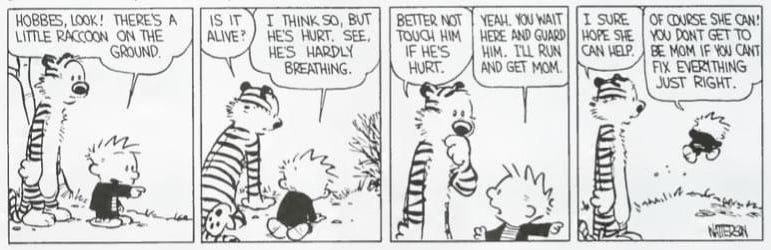
The first row ends with Calvin running off to get his mom. Hobbes expresses a wish that she can help, to which Calvin says, “Of course she can! You don’t get to be a mom if you can’t fix everything just right!”
When I first read this as a kid, terrified of falling asleep, deeply disturbed by the unknown that might attack me, I too wanted my mom and dad to fix everything “just right”. I wanted nothing more than to undo what I saw, undrink the caffeinated soda, crawl back into the innocence that I once had. But parents can’t do that. No one can.
In the last bit of the comic, Calvin says, “Mom says death is as natural as birth, and it’s all part of the life cycle. She says we don’t really understand it, but there are many things we don’t understand, and we just have to do the best we can with the knowledge we have.”
My mom sat at my door, being present with me while I read Calvin and Hobbes and drifted off to sleep. She and my dad did anything they could to help fix the hurt I was feeling, even if it meant buying another Calvin and Hobbes book to add to my collection.
My parents did ultimately help me fall asleep, it just wasn’t in the ways I thought it would happen. Each night as I drifted to sleep, reading and re-reading Calvin and Hobbes, I was comforted by the constant of familiarity. I saw myself in Calvin, and I learned through him many lessons, not just about death. But there was a limit, my parents would only be able to give me so many books. Bill Waterson made sure of that.
I couldn’t look for comfort in a Calvin and Hobbes TV show or carry it with me in a Calvin and Hobbes thermos. The restraint of only being able to consume so many stories of Calvin and Hobbes taught me that everything ends. It taught me, like Calvin, that I just had to do the best with what I had, with the knowledge that I had. Sleep was inevitable; I just had to put myself in the position to accept it.
I’m thrilled to have rediscovered these books, and I recommend them to anyone who has a young kid trying to make sense of the world. They’ve taught me so much about who I am. They taught me how, sometimes, cutting yourself off, even when things are going great, better serves you in the long run. Like… maybe just have four Dr. Peppers next time.
I leave you with the following quote from Bill Waterson from an LA Times Interview:

I’m glad you’re here.
Oh boy. Beginnings and endings and all the in betweens. Life is what happens between the punctuation. It all works out as it's meant to.