


Welcome back to Slacker Stuff, a weekly column for professional creatives, heads of content, or anyone else aspiring to be a creative leader.
Introduction
My partner Jenna and I watch shows from the 2000s(ish) in our free time. I’m not sure why the trend started, but it might have something to do with the fascism of the country we currently reside in and the desire for a break from constantly being tuned in to what’s going on. I enjoy contemporary TV as well (where my Pluribus fans at?), but watching a TV show created in a time gone by is like viewing the past through a small digital window.
I’ve also learned a valuable lesson about creative work by consuming these TV shows: the importance of brevity and having something of value to say. A good TV show has a strong message and gets multiple seasons to explore its premise while the audience has time to familiarize themselves with the characters. A great TV show goes beyond that. A great TV show does not overstay its welcome, because the longer a great TV show runs, the greater the risk it undoes the message and the character work that made it work in the first place.
We’ve worked through Friday Night Lights, Lost (the ending is good actually), The West Wing (always in rotation), Parks and Recreation, we’ve been devouring Survivor… but our latest watch-thru was Amy Sherman-Palladino’s Gilmore Girls. The show follows a mother-daughter duo (Lorelai, who had Rory as a teenager) as they navigate their friendship, relationships, and the quirks of small-town living in Stars Hollow, Connecticut. While Jenna had watched the show as it aired, I was new to it and had managed to avoid major spoilers for 25 years (WARNING: SPOILERS AHEAD).
It didn’t take very long into our watch-thru to feel some sort of ownership over the characters in front of us. I’m sure this is a relatable experience, you’re watching a show, perhaps not for the first time, and you’re willing the character to make a different decision that won’t result in them embarrassing or severely maiming themself. I remember watching Toy Story as a kid, thinking “Maybe Woody will be nice to Buzz this time around” (he was not). However, unlike watching something as a kid, I watched Gilmore Girls with the knowledge that there was not just an entire creative team, but studio execs behind character choices.
Make TV Longer
While this was my first watch-thru of Gilmore Girls, Jenna had seen the whole series multiple times over. I felt such joy watching something, slowly growing to love it knowing that my partner got to share something she cherishes. It becomes interesting too when Jenna knows where the twists and turns are headed and I do not. She certainly tried to warn me of the confusing decisions (especially in the later seasons).
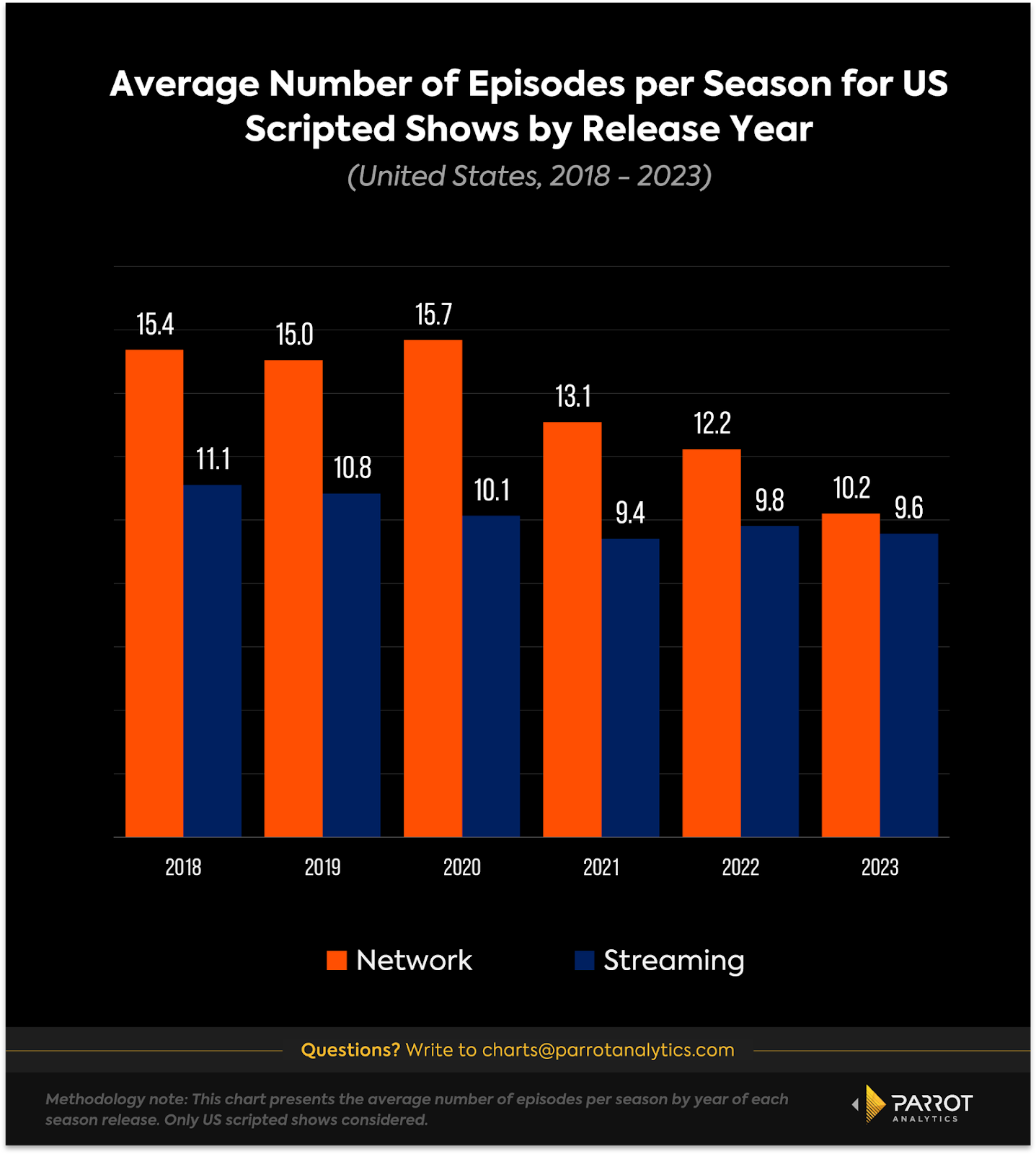
What’s fascinating about 2000s television compared to today is the number of episodes given to each season. Before the turn of the last decade, it was not unusual for comedies and dramas to have 22 episodes (or sometimes more). Now, even the most watched show in Apple-TV history gets a measly 9 episodes. Looking at stats since 2018, the average episodes per season for US Scripted shows has dropped year over year. 15.4 on major TV networks in 2018 to 10.2 in 2023.
An odd relic of the 22 episode season is the random episode that feels like the overall story doesn’t go anywhere. Plot points drag on and nonsense stories are added to fill the contractually-obligated 22 episode order. I felt this a lot watching Lost - we’ll get the backstory of a random character when all I want to do is figure out what’s making that island so spooky! Or, we get an episode where the bulk of it is seeing a specific scenario in “the hatch” play out from the perspective of three different characters.
As drawn out or distracting as these episodes can feel, I really miss the 22 episode season. The length of time allotted made it possible to develop characters over time rather than lean on montages and “x days later” cliches to prove to the audience that time has passed. As an aside: a 22 episode season also means more job stability for the cast and crew when compared to a 9 episode season. Hooray for Labor.
While we were watching Gilmore Girls, I grew attached to the characters. How can you not love Rory and Lorelai’s crazy antics? How can you not adore Luke’s curmudgeon heart of gold? How can you not hate whenever Taylor Doose is on the screen causing a ruckus and everyone excuses it because he’s apparently town dictator?
The first few seasons were positively exquisite. In the season 4 finale of the show, Luke and Lorelai finally get together. When we got to that moment I was thrilled, elated even. We had 4 seasons of getting to know these characters and why they were meant to be together. When you watch the first episode of the show, these do not appear to be two people destined to be together… but when you spend 80 plus episodes with them, it becomes readily apparent that it was always going to be Luke and Lorelai forever. The moment was earned completely, as it felt like they had been building towards this moment through all the seasons leading up to it, but not so much that it occupied the narrative of every episode.
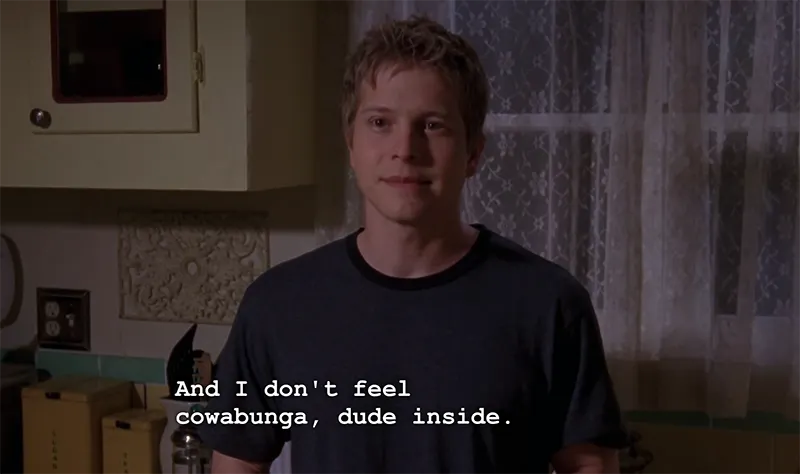
So happily ever after, right? Cowabunga, dude? Well, we still had 3 seasons to go, dear reader. To paraphrase the great Logan Huntzberger, I would not feel “cowabunga, dude” inside for much longer….
But don’t make TV too long…
It’s really hard to make something truly great. I feel like I’m still trying to make great things and I don’t know if I’ll ever make something that meets or even exceeds my taste. Quality is subjective, but consensus and time usually gives a general picture of what the masses think. I don’t mean to poo-poo on the various artists that labored for many years on a show like Gilmore Girls. From what it sounds like, Amy Sherman-Palladino tried very hard to make something great. For the most part, I think she did! Unfortunately, she was fired from Gilmore Girls between seasons 6 and 7 so the end of the series was not in her control.
For a television show to be successful, it has to balance the tightrope of intriguing viewers with conflict to stick around while also delivering satisfying payoffs so as to not upset them. It’s why I know mystery-box shows like Lost can struggle to keep folks around when they tease out situations for entire episodes (just tell me what’s in that damn hatch, JJ Abrams!). Getting enough seasons to tell a story is also not guaranteed. Some of my favorite shows were cancelled in the middle of a major narrative arc (Terminator: The Sarah Connor Chronicles is one I think about regularly). It’s because of this that a showrunner can’t always make the decisions they want to.
I’m certain that Amy Sherman-Palladino did not know how many seasons she’d get for Gilmore Girls. In fact, I found an interview with her and her husband Daniel from 2006 (after she was fired) where they talk about the uncertainty they faced when writing the show.
Daniel Palladino said: “we always wrote the show so that when a season ended, and they told us it would be the last one, we made sure there were enough things still happening, still dangling, that they’d have to pick us up for the next season.”
I’d imagine it’s difficult to wrap something up before you’re ready. I’ve been laid off before and had to give up projects that I had been working on for months. Honestly, aside from losing health insurance, that crushing blow to my psyche was the worst part. So I do get feeling the need to take the story in another direction, introducing some conflict so the audience expands and you get to keep creating. I just don’t think this conflict has to come at the expense of character development.
After the magic of the season 4 finale, Luke and Lorelai would break up and get back together in season 5… but season 7 is when they’re furthest apart with Lorelai even marrying another man (damn you, Christopher) a mere seven episodes after breaking up with Luke… and then Luke and Lorelai get back together in episode 22 (the season finale). I can’t place the blame on the Palladinos for this one. As I mentioned, they’d been laid off by season 7. The tightrope of intrigue and payoff is a challenge faced by every showrunner and creative.
Each time Luke and Lorelai break up technically has a valid reason, but it didn’t feel like a believable scenario to the audience (and consensus seems to agree). Season 7 was such a dramatic whiplash of them getting into relationship-ending arguments over a single piece of information not being shared or being shared inaccurately. Just talk to each other!
This isn’t about me “shipping” two people and deciding they should be together forever… I get it. People break up. Gilmore Girls is not the only show guilty of preventing two characters from being together for the majority of its run. But I do think story gets to a much more interesting place when one stops going back to the well and creates new situations that test and grow the characters. Parks and Recreation is a great example of this.
Leslie Knope and Ben Wyatt have a little will they/won’t they thing going on. It’s cute. Situations are created that prevent them from being together once they both realize they like each other. However, it’s not like the rest of the series is spent “will-they-ing” and “won’t-they-ing”. They very much will, folks! Instead, situations are created that bend and stretch their relationship, but don’t force them to break. It’s so much more satisfying than two characters growing to love one another and then having that progression clawed back in an attempt to stir up some drama. Ben and Leslie being together allows their characters to be more than just a couple. Their story not being focused on their relationship simply existing means it can evolve and gives the two characters the ability to grow both inside their relationship and out.
Again, I get that more seasons are not guaranteed. What if a Hollywood labor strike happened in the summer between Season 4 and 5 of Gilmore Girls? Luke and Lorelai might have kissed and we’d be left wondering: “what would have happened to them?”. Instead, Gilmore Girls ended after season 7 and the audience was still left with that very question.
Give it a rest, will ya?
I’d imagine being torn away from the show you created is, at the very least, excruciating. I’m sure watching an entire season of a show be created without her control was agonizing to Amy-Sherman Palladino. Perhaps she drove the story in a certain direction at the end of Season 6 just to feel something, ya know?
Despite the final 3 seasons of whiplash, I do look back fondly on Gilmore Girls. I’m sure, if I didn’t have the luxury of binge-watching it all in a few months, I would have given up watching it as it aired. But there were some redeeming moments during the dark ages that kept me engaged: I’m definitely Team Logan and most of his progression occurs during that time. I would have been happy if the show ended there, but then Netflix came-a-calling…

Gilmore Girls, A Year in the Life, was Amy Sherman-Palladino’s personal chance at redemption. 10 years later, she would get the opportunity to end the show on her terms. I didn’t suffer the same pain that Jenna did, having to wait 10 years to see a cherished show return and revisit beloved characters. She told me that the hype was immeasurable, staying up late and donning her P.J.s with her family in order to watch the show at midnight upon its release. What a treat to see a world you thought was gone. I only had to wait til the credits rolled on the end of the original series (just kidding, there’s a “play next” button so it was instantaneous).
Unfortunately, the revival didn’t land the way I would have liked it to. I feel confident that it wasn’t because of the quick juxtaposition of finishing the initial series and starting the revival because Jenna feels the same way. I’m also aware that the consensus seems to be that the revival is mixed (at best). It invites an important question of revivals themselves: do we need them? I feel like for the most part, you’ll never be able to re-capture the magic of that initial run. But that’s a question for a different column.
Regardless, Amy Sherman-Palladino certainly needed this. Here’s what she said after losing Gilmore Girls back in 2006:

I can imagine it’s difficult to turn down the opportunity to not only finish creating something you started but also get paid an exorbitant amount of money to do so. Apparently, she knew the exact 4 words the show would end on initially and decided to end the revival the same way. It ends with Rory saying “Mom?” Lorelai saying “Yeah?” and Rory saying “I’m pregnant”.
Through the lens of the show’s initial run, this makes sense. If this is how it ended in season 7, Rory would have been finishing up her promising college career at Yale. It would have brought the series full-circle, where Rory would have her life interrupted by an unplanned pregnancy just like Lorelai. It would have provided for an interesting discourse around the sacrifices mothers make for their children. Throughout the initial series, the audience is shown how important it is for Rory to succeed and not make the same decision her mother made. Wouldn’t it have been such an excellent, yet tragic way to wrap things up?
Instead, the revival feels like we’re picking up right where we left off in Season 6 after Amy’s departure from the show, but everyone’s 10 years older. The show may have remained in stasis for 10 years, but technically speaking the characters should have developed off-screen. The impact of the end of the revival is hollow: it doesn’t feel like Rory’s promising post-grad career is being interrupted, it feels like a lost 32 year old is becoming a parent. Hardly a dramatic conclusion… I don’t even think 22 episodes would have saved the show here. To make matters worse, guess what? Luke and Lorelai are “will-they/won’t-they-ing” again! And then they solve it by getting married, so I guess that was all for nothing.
For me and many others, the revival ruined the reputation of the characters we grew to love in the initial run. In the 10 years since the show ended, folks have created their own theories and ideas about characters. There’s a natural, believable progression that happens with fandom. Without continuing the canonical story, technically no one would have been wrong because no one would have been right. By overstaying her welcome, Amy Sherman-Palladino sacrificed some of the good will built up by her initial project.
Conclusion
It’s something that I hope I have the foresight to avoid: at what point is it time to move on from a character? What you’re reading right now may not be fiction, but I do feel conscious of the narrative web I’m weaving week over week with this column. As I’ve said, I’m still figuring out what this column is truly about. I’m sure some of you might be lost, trying to figure out why I’m talking about TV shows from 20 years ago but, like, presumably, Amy Sherman-Palladino, I’m ultimately chasing what feels good to write about.
The beauty of writing a column for substack is: I get to write about whatever I want. I care about you, the audience, very much, but I don’t want to make something just because I think people will like it. In that way, I really do understand Amy Sherman-Palladino’s decision to end things on her terms. As I wrote about last week, I value the time you spend with me. It’s so cool that I get to produce my own “show” of sorts just like the TV shows created in a time gone by. There’s a beauty too that my only restrictions are self-imposed and I don’t have to stretch the story out just to satisfy a contract.
However, like the folks at Wistia have taught me, creative ideas are born out of constraints. One of the reasons I’ve challenged myself to put something out every Saturday at 5:05am PST is because it pushes me to get my thoughts out there instead of letting them fester and stew and ultimately result in nothing. If I didn’t set myself limits, who knows what this revival of an old favorite might turn into? I don’t know that any of us need to see what Slacker Stuff circa 2016 is if transplanted directly to 2026 without accounting for personal growth and the passage of time.
We’re probably not returning to a world where 22 episodes is the norm for a season of TV, but I’m grateful I get to go back and live in it for a while. Apparently Amy Sherman-Palladino and I share more in common than you might expect because I too have to end my piece on four words:
I’m glad you’re here.
You should give Desperate Housewives a go if you don’t know it already! Really great stories and characters that evolve over time and about 22 episodes per season