


Welcome back to Slacker Stuff, a weekly column for professional creatives, heads of content, or anyone else aspiring to be a creative leader.

I’ve always had a weird relationship with “how to YouTube” content.
There’s this entire genre of creators (How-Tubers) who make videos about how to make videos. If you search “how to succeed on YouTube” or “how to beat the algorithm,” you’ll find it immediately. And I’ve definitely had a bit of disdain for that sort of content.
Sometimes it feels a little multi-level marketing-y… like the product is teaching other people how to sell the product. The only way to win is to start telling other people how to win.
If you want to learn how to make videos, I feel like the best teacher is just to make them. If you want to learn how to do anything, just start doing it.
And at the same time, I’ve been interested in building a YouTube channel for 15 years now (wow. I’m old). I’ve made content as a career. I’ve obsessed over thumbnails and titles and pacing and sound design. So it would be kind of dishonest to pretend there aren’t principles that matter.
There’s no guarantee you’ll be successful on YouTube. But there are ingredients.
If I had to boil it down, if I had to say, here are the only things you really need to consider, this is what I’d say:
1. Show Up (Have a Forcing Function)
The number one thing is just showing up. I’ve talked about this before but it’s important to drive home the point: just make stuff.
Figuring out a regular rhythm that allows you to show up. If you stick to a schedule, your behavior becomes mapped to meeting that deadline. Something is better than nothing.
For me, I’ve told myself that every Saturday at 5:05am, I am going to put something out. It doesn’t matter what it is. That’s my forcing function. It prevents me from being a perfectionist. It prevents me from fixating on the perfect idea. It keeps me from saying, “If I just made this graphic 10% better, then I can upload.”
In my experience, if you don’t give yourself a deadline, you can just never show up. I can’t guarantee that you’ll be successful in your creative endeavors if you follow all the steps laid out in this column, but I can guarantee you won’t succeed if you don’t put things out there.
2. Advice Is Contextual (The Best Teacher Is Doing)
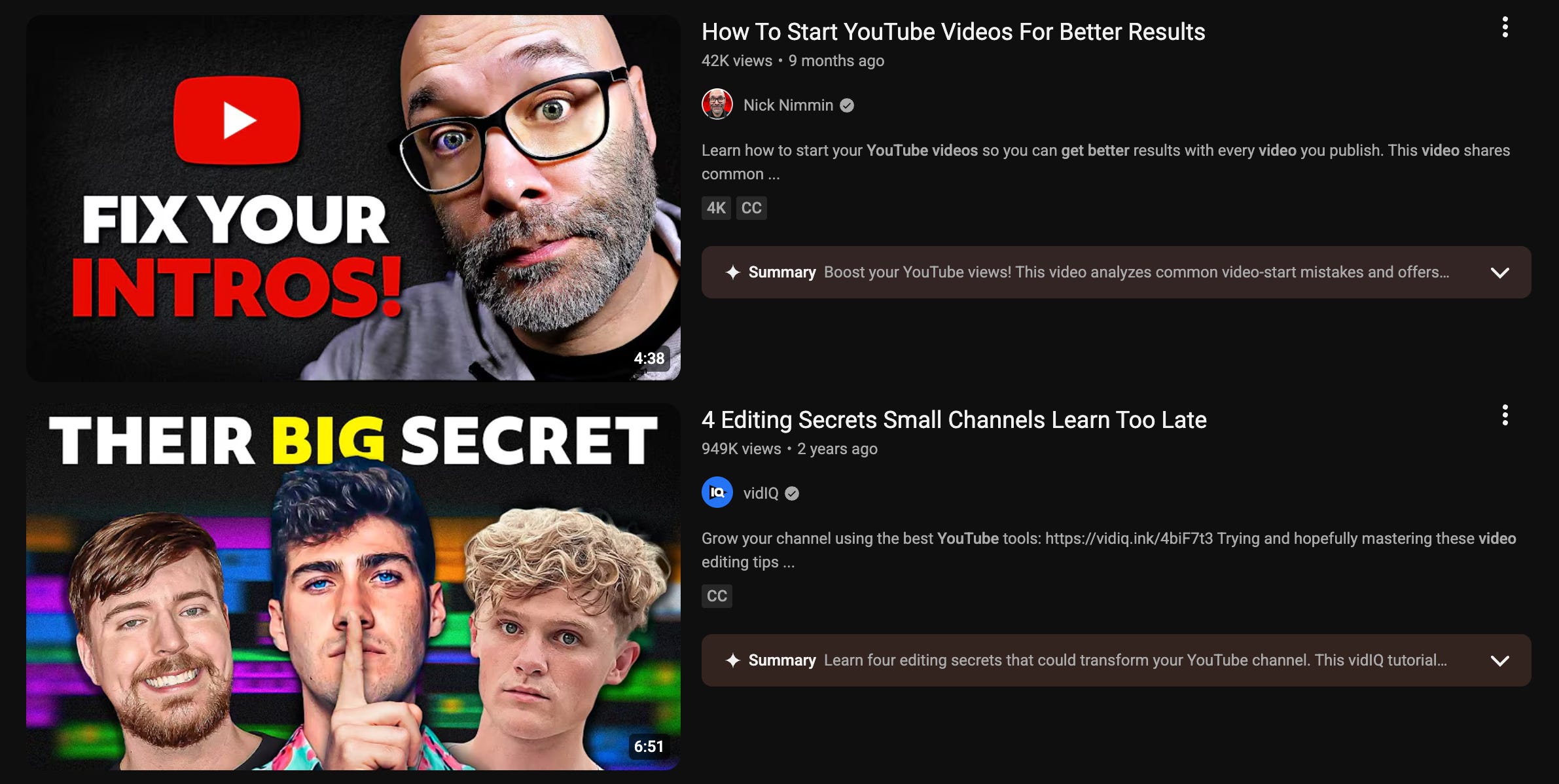
Advice is easy to give. My experience is my experience. I can tell you what worked for me. And, yes, there are common principles: You wouldn’t see all these channels teaching how to make a good YouTube video if there weren’t patterns that worked.
But there are also so many examples of people being successful on YouTube making wildly different kinds of content. There’s an audience for the obscure. There’s an audience for something different. Most advice exists because it worked for that person.
The best teacher is actually doing it yourself. Try things. The worst thing that happens? You make a video that stinks. And if it doesn’t perform well? Relax. Nobody saw it. You can just move on and make the next one.
3. Quality vs. Quantity Is the Wrong Question
Quality does matter… But the quality versus quantity debate doesn’t have a clean answer. The real answer is cadence first, then meet quality within that cadence.
If you have a regular rhythm that allows you to show up consistently, that is everything. Then within that time constraint, you dial in the quality as much as you possibly can. And quality, to me, is attention to detail.
That’s:
Graphic language
Spelling mistakes (I struggle with this still)
Filmmaking language
Writing
Sound design
How all the above melts together in the pot
There are principles that are true. Understanding language, whether it’s filmmaking language or writing language, matters. Showing your audience that you care about the details shows them that their time is well spent. Lord knows there’s plenty of other options for folks to consume. Make it worth their while.
So the debate ends like this: show up consistently, and within the time you’ve given yourself, make it as good as you possibly can.
4. Learn the Platform You’re On

Different platforms have different rules.
When I first started uploading to TikTok, I wasn’t getting views. I was posting the same short videos I was putting on YouTube. I was confused.
A friend pointed out that I was baking subtitles into my videos instead of using TikTok’s native subtitles… which they use for indexing the content.
As soon as I changed that, the videos performed better. A lot better.
All the different platforms that are out there have rules. It can be extremely overwhelming to keep up with every single one, and by no means do you need to be everywhere, but knowing the specifics of those platforms are essential.
On YouTube Shorts, two metrics matter most:
Stayed to watch vs. swiped away
Average view percentage
If you can get that average view percentage up near 80%, your Short is probably going to do well.
With long-form YouTube, packaging is everything.
Thumbnail.
Title.
The first thing you say.
The first thing you show.
You need a strong click-through rate. But if it’s clickbait and you don’t deliver on the promise, people are going to hate it. A video’s retention, how long people are watching your video, in tandem with click-through rate work together to determine if a video gets more views. That’s why you need strong packaging… and then you need to actually deliver on the promise.
That’s the whole ballgame.
5. Niching Down Makes It Easier (But It Has to Be Real)
Niching down is something you’re going to hear everywhere. And it works. But you have to actually have expertise in that niche.
Let’s say I decided I want to be a pocket knife YouTuber. I’ve got a couple pocket knives. But I don’t know enough to actually be trusted. I could probably fake it with some B.S. and ChatGPT and stuff like that… but your audience will see straight through it.
If you’re passionate about something, try it. See if people are into it. Especially if it’s something that isn’t regularly served. You might find there’s an untapped market out there.
At my main job, I’m the Director of Programming for Mostly Media. We run two podcasts: Run the Numbers and Mostly Growth Run the Numbers is for CFOs and aspiring CFOs.
There is CFO content out there. But it’s not nearly as saturated as “how to grow on YouTube” content. It’s a much narrower niche. There’s less competition. And I think one reason we’re successful in that niche is because we’re the best at it. We focus heavily on quality. We care about the details. We go deep. We stick to the principles I’m speaking about in this column.
By being specific, and by caring about quality and consistency, it makes growth easier.
I struggle with this personally. This Substack? I don’t fully know what the niche is. I’ve tried to say it’s for creative leaders or aspiring creative leaders… But I’ve talked about Disney, Blockbuster, YouTube, Costco Hot Dogs (more on that soon). Whatever I’m thinking about. I don’t want to be put in a box.
And I think it’s possible to not have a niche. But it is demonstrably more difficult to make a living on YouTube without one. It’s just harder.
If you stick to the principles we’ve talked about, you can grow either way. But having a niche makes it easier.
6. You Have to Actually Like This
This might sound dumb, but I really think people overlook it. You have to like making videos. You have to like telling stories. There’s definitely a lure to being a YouTuber. For a while, it was the number one job kids wanted and it’s still at the top of many kids’ lists. I was one of those kids.
But it’s still a job. The hardest part about putting my work on the internet is being sucked into the depths of view counts and the rabbit hole of analytics that dictate success. As I’ve discussed, there’s important metrics to consider, but refreshing “studio.youtube.com” every 5 minutes will not change the results.
When you look at top creators, you mostly see the fun part, because that’s what they craft and publish. You don’t see the schedule. You don’t see the weeks when views aren’t what you want them to be. The grind of consistency is obscured by the glitz and glamour of the edited export.
It’s hard.
And when it gets hard, something has to carry you through. If you don’t enjoy the process, not just the results, it’s going to be very difficult to sustain.
That part is huge. In fact, it’s everything.
So no, I don’t love the genre of “how to YouTube.” But after all this time, if I had to reduce it:
Show up.
Experiment.
Balance cadence with quality.
Understand the platform.
Consider your niche.
Enjoy it.
Don’t get sucked into optimizing content and fall for the trap of the How-Tuber MLM. There’s no formula that guarantees success. But if you don’t show up, don’t learn, don’t iterate, don’t respect the platform, don’t understand who you’re for, and don’t like doing it — you definitely won’t succeed.
That’s what I think actually matters.
I’m glad you’re here.
Just do it! That's the ticket.
He’s cracked the code, folks